
Iran: You Don’t Negotiate with a Snake
The fall of the Islamic Republic would constitute the most significant geopolitical transformation since the collapse of the Berlin Wall - writes Rouzy Vafaie

You don’t reason with something whose incentives are fixed. You don’t compromise with a force that survives by your submission - or calls for your death, as political leaders in the Islamic Republic of Iran have done for forty-seven years.
Sir Winston Churchill famously said, “you cannot reason with a tiger when your head is in its mouth.” Because negotiation assumes common ground, and there is none between the Islamic Republic, the United States of America and in fact the entire free world.
This reality becomes even more relevant after the month-long joint US-Israeli onslaught on the Islamic Republic.
Many inside Iran were shocked, sad and worried what would happen to them if the Islamic Republic continues to control Iran and there is a permanent peace with the United States.
The reasons are long, terrifying and seemingly changing by the hour.
Even as news of a ceasefire came, the authorities in Iran continued to keep its citizens under an internet blackout that has now lasted more than sixty days. Domestically, authorities are recorded saying they will “skin” people that stood against them before the conflict, during it and even now. One can only feel sorrow knowing what will happen to normal people if America and Israel’s boot is off the regime’s neck.
When the one hundredth day of mourning occurred from the January 2026 massacre - traditionally an important day of mourning for Shia Muslims - families were too afraid to gather at the graves of their loved ones. That’s because armed Islamic militia members roam the streets of major cities, wielding machine guns along with shoot to kill orders if they deem any threat to the regime. It appears that even grieving is now a threat to the regime.
Ninety million people - sans regime family members and the minority of supporters western media showcases as Iranian unity - are facing economic hardship indistinguishable to anything we face in the west.
A sangack bread - traditional Persian bread baked over pebbles in a clay cylindrical oven - was roughly 1,000 Tomans - at an exchange rate of 25,000 to $1.00 - between $0.04 - $0.06 in the summer of 2021. This week, according to a recording on Iran International’s social media, and confirmed by sources on the ground, it was selling for 50,000 Tomans - at an exchange rate of 180,000 to $1.00 - which is roughly $0.28.
Bread is a common staple in Persian culture; with variations based on what part of the country it was first used in. So this constitutes a roughly 600 percent increase in the price of a basic food group. Meanwhile, the Tomans collapse in the same period is roughly 620 percent, and according to currency exchange people I spoke with on the ground, is expected to reach to reach at least 800 percent in the coming months.
This does not translate as too costly for most H2H readers, but when you think that an Iranian teacher making roughly $500.00 a month in 2021 now makes around $200.00 today, it is a lot. Experts point to muultiple economic management reasons this has happened, but non are more signifcant than mismanagement and corruption.
The official inflation numbers from the government are between 60 - 75 percent and 70 percent from the IMF for 2026. However, if we take the sangack bread sample, then the actual inflation percentage is around 600 percent. This constitutes hyperinflation; it is my opinion the only factor preventing the Islamic regime from total collapse would be the lifting of American sanctions.
All of the economic pain assumes you have a job. The authorities have essentially shutdown the internet for the majority of 2026. According to NetBlocks, it has now been shutdown for sixty consecutive days.
When I spoke with someone about how they got online - just as I had to - they told me the only way they’re getting online is buying a VPN - allegedly from an IRGC server - for roughly $16.00 to $25.00 for 3 gigabytes of data. For context, before the January uprising, I bought unlimited VPN data for roughly $5.00. During the beginning of the war, I bought 20 gigabytes of of data for $30.00. Before any reader wonders why people don’t use Starlink, the answer is because if a user goes onto an Iranian website, whose servers are all Iran based - all owned by the IRGC - the location becomes trackable. If found, that constitutes spying for the enemy; a death sentence.
That means e-commerce, entrepreneurs, crypto traders and anyone else reliant on foreign income are left sitting at home. Doctors don’t have patients, because patients don’t have money. The bazaar - central market - is still effectively shut down because the currency is too volatile, while imports and exports have ground to a halt. Moreover, the regime can’t control any aspect of the currency, as it’s reserves are depleted.
Despite the Western media portrayal of women parading on pink jeeps, holding pink AK-47’s and pink missiles, there was national dissent against the regime before the war. Interestingly, according to an IRGC source, the regime was weeks away from collapsing, and it would have, were it not for them slaughtering over 40,000 people.
Dissent and anger towards the regime will only be exacerbated this Summer, as at the very least the capital Tehran will likely run out of water and electricity; this is not the result of the war, but mismanagement and climate change.
Yet, this is precisely when Washington appears eager to make peace with a regime that rains down terror on its own people, and other countries in the region.
That instinct misunderstands the nature of the Islamic Republic; manipulative and evil. It also misunderstands the fractures within the regime. An example is when former Foreign Minister Zarif - who orchestrated the previous Iran-US nuclear deal - wrote in Foreign Affairs magazine calling for an end to the 47 years of hostility between the two countries, and was immediately rebuked by the IRGC. Just last week, the Speaker of Parliament, Mohammad Qalibaf, who was on the first negotiating team was reprimanded and rebuked for offering nuclear concession, finally being removed from the negotiating team altogether.
Internationally, assuming there isn’t a permanent peace deal, the assumption has to be that this regime will be far more belligerent than before.
Because they will claim victory against “the Great Satan,” and claim “despite the world’s most powerful military attacking us, we withstood it - we survived”. The Islamic Republic’s ideology is built on permanent confrontation, therefore expect the nations wealth to go to rebuilding its international terror network, with confidence their original strategy worked.
This was evident during the Obama years, when diplomacy did not moderate the regime’s behavior but instead provided time, resources, and legitimacy - while repression at home and aggression abroad continued unabated. This is a pattern that has held since their revolution in 1979; and it will continue.
As Lindsey Graham has argued, if President Trump follows through on his “Help is on the way” pledge, he could become a Reagan-level figure in history. Why? Because the fall of the Islamic Republic - and the emergence of a democratic Iran - would constitute the most significant geopolitical transformation since the collapse of the Berlin Wall. If he does not, he risks becoming Obama II: a president not only remembered for emboldening a terrorist regime at the moment it was most vulnerable, but by also drawing a “red line” in Syria against the use of chemical weapons, only to do nothing when that line was crossed.
The twelve-day war in 2025, followed by the bravery and sacrifice of the Iranian people, and now the 2026 devastating war represents a momentous occasion to do just that.
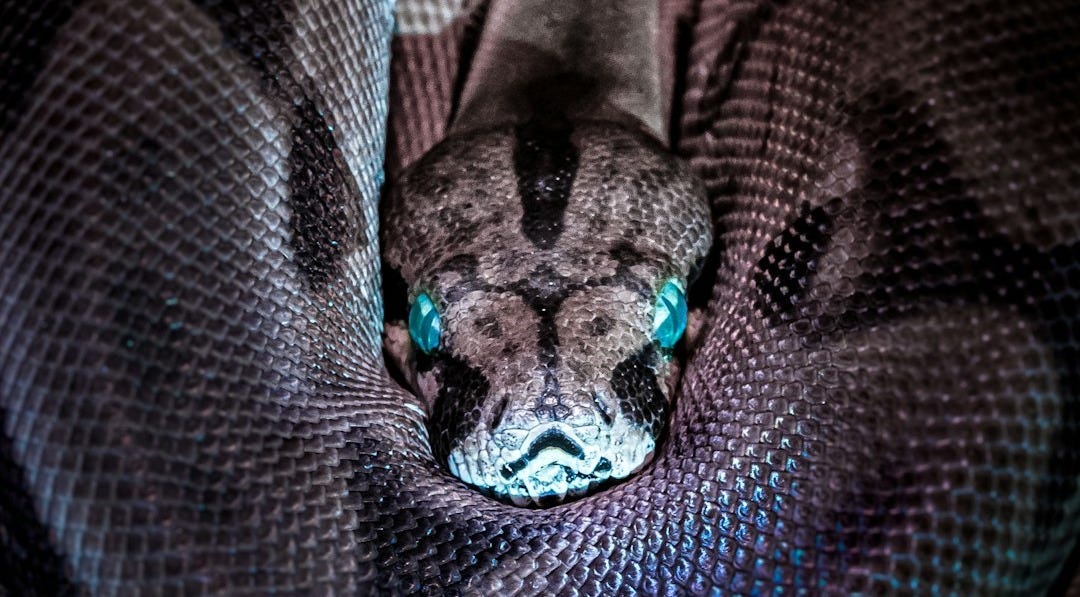
If you had an option between saving a drowning snake, or saving the Iranian regime, who would you pick? I would pick the snake, because at least I know its nature. The mullahs occupying Iran will present wheat with one hand as a gesture of peace, while terrorizing its own people at home, and planning on how to hold the world hostage in the near future.
You don’t negotiate with a snake whose sole purpose is to kill you; you burn it.
Iranian-American Rouzy Vafei escaped Iran in March 2026; he was detained at the border and interrogated and beaten by IRGC soldiers. He is now safely in the West.


